From the Centers for Disease Control and Prevention (CDC):
Deaths from prescription painkillers have reached epidemic levels in the past decade. The number of overdose deaths is now greater than those of deaths from heroin and cocaine combined. A big part of the problem is nonmedical use of prescription painkillers—using drugs without a prescription, or using drugs just for the "high" they cause.
Showing posts with label prescription drug abuse. Show all posts
Odyssey magazine focuses on addiction
The September edition of Odyssey, a science magazine for middle school students, focuses on addiction. Among the many articles are:
-- Facing Up to Underage Drinking
-- Bad Bet with the Brain: The Neuroscience of Addiction
-- Are Cell Phones Addictive?
-- Pain Pills?
-- Facing Up to Underage Drinking
-- Bad Bet with the Brain: The Neuroscience of Addiction
-- Are Cell Phones Addictive?
-- Pain Pills?
Opiate use in Washington State
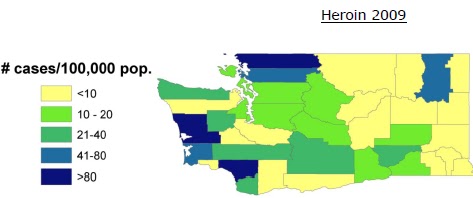
Washington State, like much of the United States, has seen a tremendous increase in the use and negative consequences of prescription-type opiates over the last 10-15 years, according to a Research Brief released this month by the University of Washington's Alcohol and Drug Abuse Institute. The brief goes on to state: Prescription-type opiates appear to be a pathway to heroin for many users . . .
The maps below are from the brief and show the increases in the Washington State opiate problem between 2000-2009. (Rx = prescription)
Prescription drug abuse leading to heroin abuse
Yesterday, KING5 broadcast a story about a teenager who recently died from a heroin overdose.
Dean Shumway died of a heroin overdose just before his 19th birthday. He did not fit the stereotype of a heroin addict, down on his luck and homeless--but perhaps Dean does represent what's becoming the new face of heroin addiction: white middle class teenager.
Frank Couch, a counselor with Science and Management of Addictions (SAMA), says Dean is not an isolated case.
"It's a huge problem out there. It's a huge problem with young folks and adolescents,” said Couch.
Couch says these kids used to smoke Oxycontin, but now that the prescription painkiller has been reformulated, they're turning to heroin.
"It's cheaper, it's more readily available so the trend is moving back to heroin use again," he explained.
Dean Shumway died of a heroin overdose just before his 19th birthday. He did not fit the stereotype of a heroin addict, down on his luck and homeless--but perhaps Dean does represent what's becoming the new face of heroin addiction: white middle class teenager.
Frank Couch, a counselor with Science and Management of Addictions (SAMA), says Dean is not an isolated case.
"It's a huge problem out there. It's a huge problem with young folks and adolescents,” said Couch.
Couch says these kids used to smoke Oxycontin, but now that the prescription painkiller has been reformulated, they're turning to heroin.
"It's cheaper, it's more readily available so the trend is moving back to heroin use again," he explained.
Robberies at WA pharmacies increased seven-fold since 2003
To follow up with my post from earlier today, below is a chart regarding the rising number of pharmacy robberies in Washington State. According to the report, "Most are for prescription-type opiates, especially OxyContin, and are often committed by organized groups engaging in drug distribution."
Source: Tobacco, Alcohol, & Other Drug Abuse Trends, 2010 Report, Washington State Division of Behavioral Health and Recovery.
Youth substance abuse prevention part of national strategy
As part of the federal Affordable Care Act (health care reform), the first ever National Prevention Strategy was recently released. The Strategy's goal is to increase the number of Americans who are healthy at every stage of life.
One of the Strategy's priorities is preventing drug abuse and excessive alcohol use. Preventing underage drinking is included. Among its recommendations under this priority are:
-- the implementation and enforcement of alcohol control policies. "States with more stringent alcohol control policies tend to have lower levels of binge drinking among adults and college students. Evidence-based policies that decrease excessive alcohol use and related harms include those that prohibit the sale of alcohol to minors and intoxicated persons; reduce days and hours of sale; and limit the number of places that legally sell alcohol."
-- create environments that help young people avoid drugs and alcohol. This includes reducing youth exposure to alcohol marketing.
-- identify drug and alcohol problems early and provide intervention, referral, and treatment.
-- reduce inappropriate access to prescription drugs.

One of the Strategy's priorities is preventing drug abuse and excessive alcohol use. Preventing underage drinking is included. Among its recommendations under this priority are:
-- the implementation and enforcement of alcohol control policies. "States with more stringent alcohol control policies tend to have lower levels of binge drinking among adults and college students. Evidence-based policies that decrease excessive alcohol use and related harms include those that prohibit the sale of alcohol to minors and intoxicated persons; reduce days and hours of sale; and limit the number of places that legally sell alcohol."
-- create environments that help young people avoid drugs and alcohol. This includes reducing youth exposure to alcohol marketing.
-- identify drug and alcohol problems early and provide intervention, referral, and treatment.
-- reduce inappropriate access to prescription drugs.
KING 5: How to prevent teen prescription drug abuse
Saturday was Prescription Drug Take-Back Day and KING 5's HealthLink explains how such programs help prevent youth prescription drug abuse.
Coalition learns about Take Back Your Meds campaign
During yesterday's Prevention WINS meeting, coalition members learned about the local Take Back Your Meds campaign.
Legislation currently being considered in the Washington State Senate would create a secure medicine return program in our state. This bill could have a significant impact on youth substance abuse prevention. During recent coalition meetings, we've heard reports about youth abuse of prescription medications on the rise. Prevention science confirms that reducing access to harmful substances is a proven method for preventing youth substance abuse. For the legislation to move forward, the Senate Rules Committee will need to vote on it by March 7. Pharmaceutical companies who oppose the bill are working hard to ensure that the bill does not get a full Senate vote.
April 30: National Prescription Drug Take Back Day
The number or teenagers abusing prescription drugs is increasing nationwide. Studies show that a majority of abused prescription drugs are obtained from family and friends, including the home medicine cabinet.
In an effort to address this problem, a National Prescription Drug Take Back Day took place September 25, 2010. Due to the overwhelming success of the first event, the DEA is planning a second National Prescription Drug Take Back Day which will take place on Saturday, April 30, 2011. This will be a great opportunity for those who missed the first event or who have subsequently accumulated unwanted, unused prescription drugs, to safely dispose of them.
Local collection sites are listed on the Take Back Your Meds website.
In an effort to address this problem, a National Prescription Drug Take Back Day took place September 25, 2010. Due to the overwhelming success of the first event, the DEA is planning a second National Prescription Drug Take Back Day which will take place on Saturday, April 30, 2011. This will be a great opportunity for those who missed the first event or who have subsequently accumulated unwanted, unused prescription drugs, to safely dispose of them.
Local collection sites are listed on the Take Back Your Meds website.
Preventing prescription drug abuse
As I meet with community members, the topic of youth prescription drug abuse keeps coming up. People who work with teenagers report an increase in the number of young people who are abusing prescription drugs. According to the 2008 Healthy Youth Survey, 12% of Washington high school seniors abuse medicines.A local coalition is advocating for drug take-back programs where Washington residents can bring their unwanted medicines to be properly destroyed. Their website includes fact sheets and other resources that community members can use to increase understanding and awareness of the issue.
DOH website about pain medications
The Washington State Department of Health has a new website about prescription opioid pain medicine that includes information for teens, parents, pain patients, and others.
Prescription drug abuse topic of SAMA luncheon
Today I attended the"Knowledge is Power" luncheon for the Science and Management of Addiction Foundation (SAMA) and heard Stephen Pasierb, the President and CEO of the Partnership for a Drug-Free America speak about their campaign targeting parents.
SAMA's Parent Advisory Council is focusing their efforts on preventing prescription drug abuse. They encourage three simple steps when it comes to prescription drugs: Check -- Lock -- Dispose.
Subscribe to:
Posts (Atom)