Showing posts with label underage drinking. Show all posts

NIH release clinicians guide to screen for underage drinking

From a recent NIH news release:

Based on just two questions from a newly released guide, health care professionals could spot children and teenagers at risk for alcohol-related problems.  Alcohol Screening and Brief Intervention for Youth: A Practitioner's Guide is now available from the National Institute on Alcohol Abuse and Alcoholism (NIAAA), part of the National Institutes of Health. 

We know that alcohol is by far the drug of choice among youth,” says NIAAA acting director Kenneth R. Warren, Ph.D. “Underage drinking is also a marker for other unhealthy behaviors and it often goes undetected. This new tool was designed to allow busy practitioners who manage the health and well-being of children and adolescents to conduct fast, effective alcohol screens and brief interventions.”

The American Academy of Pediatrics (AAP) says doctors should routinely screen their teenage patients for drug and alcohol use at every visit, and look for signs of dependence or addiction.  In a new policy statement, the group provides a guide to help doctors ask adolescents about substance abuse issues.

More on how underage drinkers access alcohol

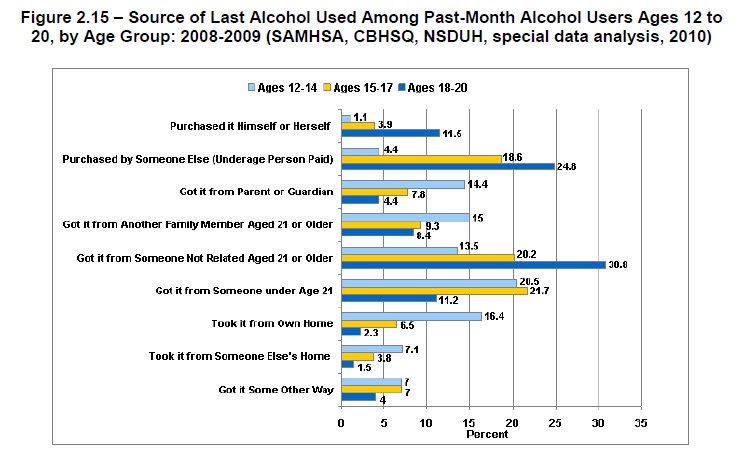
In July, I posted data about how underage drinkers in our community get alcohol.  The top two ways are "got it from friends" and "got it at a party".  While the Prevention WINS coalition is working to figure out exactly where the alcohol comes from, national statistics indicate that high school youth (ages 15-17) get alcohol from:
  1. someone under the age of 21 (22%)
  2. someone not related and over the age of 21 (20%)
  3. giving someone else money to purchase alcohol (19%).

Source: Report to Congress on the Prevention and Reduction of Underage Drinking, U.S. Department of Health and Human Services, May 2011

Underage drinking rates decline thanks to community-wide prevention activities

More than 50 people attended Monday's Celebrate Healthy Youth at Nathan Hale High School and learned about how the community in northeast Seattle came together to reduce underage drinking rates.  Following are links to media coverage of the event. 

How alcohol use was cut at two Seattle schools (Seattle Times)

Finding: North Seattle teens are drinking less (KOMO)

More about underage drinking in public parks . . .

From the West Seattle Blog: Teacher’s disturbing discovery in West Seattle park: Hazing.  Though the incident took place in West Seattle, it apparently involved Roosevelt and Garfield High School students. 

Odyssey magazine focuses on addiction

The September edition of Odyssey, a science magazine for middle school students, focuses on addiction.  Among the many articles are:

-- Facing Up to Underage Drinking

-- Bad Bet with the Brain: The Neuroscience of Addiction

-- Are Cell Phones Addictive?

-- Pain Pills?

Youth drug abuse a "big problem" according to adults

Adults rate drug abuse and obesity as the top health concerns for children, according to a recent study


After drug abuse and obesity, tobacco use is ranked third and alcohol abuse is ranked eighth. 

The report goes on to state, "Drug abuse rises to the top of the list of child health concerns in 2011, with one-third of adults overall rating drug abuse as a big problem . . . Whether this increased concern translates to greater support for drug prevention and/or drug treatment programs remains to be seen."

Liquor privatization: public health costs

While the Seattle Times "cheers Initiative 1183" because it would generate additional revenue for state and local governments, the Washington State Budget & Policy Center questions whether the additional revenue would offset costs associated with increased public health, safety, and economic implications. 

In a recent post to their Schmudget blog, the Budget & Policy Center states that the Washington State Office of Financial Management's (OFM) analysis "does not account for future costs associated with greater consumption of hard liquor.  They estimate that hard liquor sales (consumption) would increase by about five percent under I-1183.  However, a 2010 report from the State Auditor's Office estimated that consumption of hard liquor could increase by as much as 15 percent under a privatized liquor system similar to that proposed by I-1183.  Either way, our state could face increased public health and safety costs under the initiative -- due to higher rates of drunk driving and other alcohol-related crimes." 

An increase in underage drinking is one of those public health and safety costs.  Increased availability of alcohol through stores means increased problems with underage drinking, according to many research articles (which may be found in the ADAI Library Resource Brief about Privatization of Alcohol Sales, page 4).

Adolescents' alcoholic beverage preferences are shifting from beer to distilled spirits

Distilled spirits are becoming more popular among adolescent drinkers and are challenging beer as the alcoholic beverage most likely consumed by underage drinkers, especially among youth who report binge drinking, according to a recent Health and Human Services report to Congress.  Flavored alcoholic beverages are also popular.


The charts above show the alcoholic beverages of choice among female and male high school seniors who drink.  The red line represents flavored alcoholic beverages, the dark blue line represents beer, and the light blue line with squares represents distilled spirits. 

According to the report, beverage preferences vary somewhat by state.  Data from four states indicated that, among high school students who reported binge drinking, liquor was the most prevalent alcoholic beverage type.

Alcohol marketing influences adolescent binge drinking

Two-thirds of underage drinkers report having a favorite brand of alcohol, according to the results of a recent study published in the Archives of Pediatrics & Adolescent Medicine.  Hard alcohol brands were identified as favorites as often as beer.  "Brands preferred by youth tended to have high advertising expenditures, and choosing a favorite brand was associated with binge drinking." 

The article concludes, "The correlation between underage drinkers' brand preference and marketing expenditures suggests a marketing influence on choice of beverage. Moreover, higher rates of binge drinking among adolescents who named a favorite brand suggest that alcohol advertising campaigns may influence the likelihood that alcohol will be consumed at levels that pose a risk to health."

More about alcohol marketing and youth is available at the Center on Alcohol Marketing and Youth's website.

Youth drug use at Laurelhurst Park

A recent post to the Laurelhurst Blog describes the ongoing parties at Laurelhurst Park.  Following is an excerpt:

We regularly smell cigarette and marijuana smoke coming from that direction and have seen kids (only boys although that doesn’t mean girls haven’t been there) running up there with backpacks on (often coming on bike or scooter and even out walking their dog in daylight). They tuck deep in the corner and have complete coverage.

Currently there are broken beer bottles, in-tact bottles as well as a strong smell of urine.

If people are missing their junior high boys, I suspect they’d find them here… I’d guess these kids are junior high or early high school.
 
On Friday, I posted information to this blog about underage drinking parties at Magnuson and Golden Gardens.

Police report that parties at parks continue

During the coalition's Advocacy Workgroup meeting earlier this week, a Seattle Police Officer reported that large underage drinking parties continue to occur at Magnuson Park. 

On the last day of school, Seattle Police broke up a large party at Magnuson Park.  Despite a warning posted at a nearby high school that police would be conducting alcohol emphasis patrols on the last day of school, more than 100 minors were at the party.  If stickers on cars can be relied on for identification purposes, most minors were students at the nearby high school.  The officer noted that many high school students also participate in underage drinking parties at Golden Gardens.  Alcohol has been a factor contributing to recent violent incidents at the park.

The Advocacy Workgroup continues to plan for meeting with local policy makers about the implementation of laws already on the books regarding youth alcohol and marijuana use.  Short-term plans include meeting with City and County council members who serve on health and safety-related committees. 

Alcohol advertising & teen drinking

From a recent article published in Medscape Medical News:

Alcohol marketing is effective. Although profitable for the manufacturers, the detrimental results seen in American adolescents — who are not the target audience — are increased frequencies of drinking and binge drinking, which could be a prelude to alcohol-related behavioral and health problems in later life.

Meanwhile, according to an article in the Economist, "People in rich countries are not drinking enough beer. By volume, sales in 2010 fell by 1.5% in America and 2.3% in western Europe . . "  This means that the "big four" brewers will be increasing their marketing campaigns in an effort to revive beer sales.  "Their dream is to sell beer like premium-priced detergent," according to the article.

This news comes on the heals of a study about youth exposure to alcohol ads:
 
Youth exposure to alcohol advertising on U.S. television increased 71 percent between 2001 and 2009, more than the exposure of either adults ages 21 and above or young adults ages 21 to 34, according to an analysis from the Center on Alcohol Marketing and Youth (CAMY) at the Johns Hopkins Bloomberg School of Public Health.

Adolescent health care providers call for binge drinking prevention activities

The Society for Adolescent Health and Medicine (SAHM) is hosting their annual meeting in Seattle this week and I was looking at their website and came across their October 2010 press release about binge drinking.  Following are a few excerpts:

In light of the Centers for Disease Control and Prevention’s (CDC) recently released report on binge drinking among high school students and adults in the United States in 2009, the Society for Adolescent Health and Medicine (SAHM) called today for strong and directed action by health care professionals, community and policy leaders, local officials, schools, religious groups and community members to develop and implement programs and policies to curb the rise in binge drinking among adolescents and young adults in the United States.

“This report reaffirms,” said Dr. William Adelman, Chair of SAHM’s Alcohol and Drug subcommittee, “that binge drinking is a particularly serious problem for adolescents as well as adults in the United States but that the majority of underage drinkers are apparently learning to drink alcohol with the expressed goal of intoxication. It is no surprise then, that binge drinking disproportionately affects those in high school and then through age 25, too often with tragic outcomes.”

. . . community-based interventions such as those recommended in the Guide to Community Preventive Services are recommended resources for broader efforts.

Among the interventions recommended in the guide are:
-- Increasing alcohol taxes
-- Maintaining limits on days of sale
-- Maintaining limits on hours of sale
-- Regulation of alcohol outlet density
-- Enhanced enforcement of laws prohibiting sales to minors

What teenagers think adults think about youth alcohol, tobacco and marijuana use


These charts show the percent of King County and Washington State 6th, 8th, 10th, and 12th grade students who report that adults in their neighborhoods think youth alcohol, tobacco, and marijuana use is "very wrong".  As you see, the older children get, the less likely they are to think adults disapprove of drug use.  

Source: 2010 Healthy Youth Survey.  King County results are posted on the Prevention WINS website.

Youth perceive risk of harm from tobacco and use it at lower rates than alcohol and marijuana


These charts show the percent of King County and Washington State students in grades 6, 8, 10 and 12 who report great risk of harm from using different substances.  (Source: 2010 Healthy Youth Survey -- HYS.)  Results from the 2010 HYS also show that tobacco use rates among youth are much lower than the rates of youth alcohol and marijuana use.

Teenagers find it easy to get alcohol


State and King County results from the 2010 Healthy Youth Survey (HYS) were recently released.  Among the questions that students in grades 6, 8, 10 and 12 were asked is how difficult it would be to get alcohol, cigarettes and marijuana.  As is shown in the charts above,  perceived availability declines significantly for all substances as children get older.  HYS results also show that adolescents find it easier to get alcohol and cigarettes, both legal and regulated, than it is to get marijuana.

In the news

State liquor laws in the news:


Monitoring the Future in the news:

Though I blogged about this before, here is a link to what appeared in the Seattle PI: Teen pot smoking at 30-year high. Someone who posted a comment after the PI article noted that nobody is talking about how youth alcohol and tobacco use rates have decreased. Considering I had blogged about accentuating the positive in communities right before I blogged about increasing rates of youth marijuana use, I took that comment to heart. Communities across the nation have focused quite a bit on preventing youth alcohol and tobacco use and these successes should be recognized and celebrated. Prevention does work!

National drug policy in the news:

Questions for the Drug Czar (The Nation) Here's an excerpt in which Gil Kerlikowke talks about prevention:

I do not underestimate people's frustrations or strong feelings about a lack of success in the war on drugs, whether in the US or worldwide. It's been going on forty-five years, yet people still know their child can get drugs in high school, that their neighborhood has drug dealing, or they have a friend or neighbor or co-worker impacted by drugs. Where we have so clearly failed is not helping people understand there are very cost-effective, basic ways of working through prevention, understanding treatment can be effective and it's half the cost of incarceration. We don't have to throw up our hands as a nation and say the war on drugs has failed and therefore we have to go for legalization. We should look at these other prevention and treatment issues.

Mental health in the news:

Serious mental health needs seen growing at colleges (New York Times) Alcohol and drug abuse are included in the mental health needs discussed in this article.

Youth substance abuse treatment for alcohol and marijuana

To follow up with an earlier entry about King County youth substance abuse treatment trends . . .

Youth treatment admissions are different from adult admissions
While marijuana and alcohol are the top two drugs used by youth admitted into treatment, with marijuana way ahead of alcohol, adult treatment admissions tell a different story. Among adults admitted into treatment in King County, alcohol is by far the primary drug. Illegal drugs round out the top five: cocaine, heroin, marijuana, and meth.

Most people who are addicted to alcohol and marijuana start using as youth
Of all people who entered treatment in King County in 2008, 81% of those who were admitted for alcohol addiction and 92% of those who were admitted for marijuana addiction started using the substances before the age of 18.

Not only does this information point toward the need for effective prevention programs among youth, it points to the importance of including youth substance abuse prevention in our conversations about marijuana decriminalization and legalization. Especially considering that the primary way that youth access needed substance abuse treatment is through the juvenile justice system. Our conversations should include how we, as a community, can prevent youth substance abuse and provide youth with access to treatment before they are in trouble with the law.

Teenagers, drinking & driving

Nearly all high school juniors and seniors believe their peers are more likely to drink and drive on prom and graduation nights according to the Center for Substance Abuse Research. Despite this perception, students do not think driving on these nights is dangerous.

In northeast Seattle, 23% of high school juniors and 33% of high school seniors report riding with someone who has been drinking.

Source: 2008 Healthy Youth Survey results for Eckstein Middle School, Nathan Hale High School, and Roosevelt High School.

Pediatrics and underage drinking

From CADCA:

The American Academy of Pediatrics issued a policy statement underscoring the critical role pediatricians play in discouraging children and teens from drinking alcohol. The policy statement, "Alcohol Use by Youth and Adolescents: A Pediatric Concern," will appear in the May issue of Pediatrics.

Alcohol consumption can interfere with adolescent brain development, and use of alcohol early in life is associated with future alcohol-related problems, because it:

-- Contributes to the leading causes of teen deaths: accidental injury, homicide, and suicide;

-- Increases greatly the chances teens will engage in other risky actions such as substance use, unsafe sex, and violent behavior;

-- Affects developing brains and general health, including possibly harming liver function and ability to fight infections.

The authors recommend additional research into prevention, screening and identification, brief intervention and management, and treatment of alcohol and other substance use by adolescents.