The Washington State Coalition to Reduce Underage Drinking (RUaD) is offering stipends for community organizations that want to conduct a Let's Draw the Line Between Youth & Alcohol campaign and/or a town hall meeting about underage drinking.
RUaD has been asked by the Substance Abuse and Mental Health Services Administration (SAMHSA) to submit the names of 100 Washington communities that would like to host town hall meetings. Participants will receive a $500 stipend to underwrite costs of the meetings. Contact RUaD by December 2 if your organization is interested.
Groups can receive a $1000 stipend for conducting a Let's Draw the Line campaign. Groups may sign up on December 1 by visiting http://www.letsdrawtheline.org/.
Showing posts with label Washington State. Show all posts
Showing posts with label Washington State. Show all posts
Washington now has 31 coalitions funded by Drug Free Communities grants

Twenty-eight Washington State Drug Free Communities continuation grantees, including Prevention WINS, were awarded ongoing funding. Additionally, three new DFC grants were awarded in Washington State. Congratulations to the following new grantee coalitions:
1. Kittitas County Community Network Coalition (fiscal agent Kittitas Valley Community Hospital)
2. Pend Oreille County Youth Task Force (fiscal agent Pend Oreille County Counseling Services)
3. Citizens for Safer Yakima Communities (fiscal agent Educational Service District 105)
A mentoring grant was awarded to Prevent! The Substance Abuse Coalition of Clark County (fiscal agent Educational Service District 112).
Across the country, 87 new grants were awarded which brings the total of DFC grants awarded for 2011 to 694, including continuation grants.

Opiate use in Washington State
Washington State, like much of the United States, has seen a tremendous increase in the use and negative consequences of prescription-type opiates over the last 10-15 years, according to a Research Brief released this month by the University of Washington's Alcohol and Drug Abuse Institute. The brief goes on to state: Prescription-type opiates appear to be a pathway to heroin for many users . . .
The maps below are from the brief and show the increases in the Washington State opiate problem between 2000-2009. (Rx = prescription)


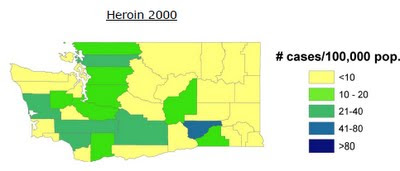

The maps below are from the brief and show the increases in the Washington State opiate problem between 2000-2009. (Rx = prescription)


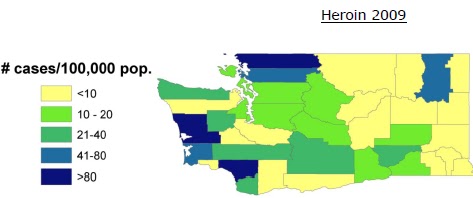
Student testimony illustrates why school-based prevention & intervention services are needed
In NE Seattle, high school students have little to no access to school-based drug/alcohol prevention intervention services. Why are these services important? Check out what a Garfield High School student says during his testimony in favor of HB 2014. His testimony starts at about 19 minutes into the session. Testimony from students from another school district starts at about 44 minutes.
Thanks in part to student's testimony, HB 2014 passed the House State Government and Tribal Affairs Committee with a 7-4 vote! The bill moves on to the House Ways & Means Committee, yet to be scheduled. Northeast Seattle Representative Kenney is a member of this committee.
With a 10% increase in alcohol licensing fees, HB2014 would generate approximately $1.2 million in revenue to go towards preventing youth substance abuse and providing needed school-based intervention services. For more information, the Washington Association for Substance Abuse and Violence Prevention has created a HB2014 Fact Sheet.
Thanks in part to student's testimony, HB 2014 passed the House State Government and Tribal Affairs Committee with a 7-4 vote! The bill moves on to the House Ways & Means Committee, yet to be scheduled. Northeast Seattle Representative Kenney is a member of this committee.
With a 10% increase in alcohol licensing fees, HB2014 would generate approximately $1.2 million in revenue to go towards preventing youth substance abuse and providing needed school-based intervention services. For more information, the Washington Association for Substance Abuse and Violence Prevention has created a HB2014 Fact Sheet.
Secure medicine take-back bill fails in WA Senate

“While many Senators were strongly in favor of this bill, pressure from the pharmaceutical industry managed to derail a good piece of legislation that would help protect our families and the environment from left-over medicines. It’s unfortunate that common sense and innovation were left on the sidelines in favor of backroom politics. Washington desperately needs a secure system to safely dispose of leftover medicines from homes without hurting the environment. It’s time to put our families first, not the pharmaceutical companies,” said Karen Bowman, RN, Washington State Nurses Association.
Gearing up for next year . . . Secure medicine return bills are NOT dead for all time. The Legislature works in two-year cycles - this is year one of the 2011-2012 biennium. Every bill introduced this year is automatically re-introduced next year.
At the start of the 2012 session, SSB 5234 will start in the Senate Rules committee. If we can encourage more Senators to support the bill between now and then, SSB 5234 could be pulled straight out for a floor vote.
HB 1370 will also be reintroduced in the House.
Subscribe to:
Posts (Atom)